
In this essay, Trish Prentice of the Scanlon Foundation Research Institute shares the stories of emergency service volunteers from diverse cultural and religious backgrounds who are making an impact out in the field and paving the way for broader institutional change. The following is one of their stories.
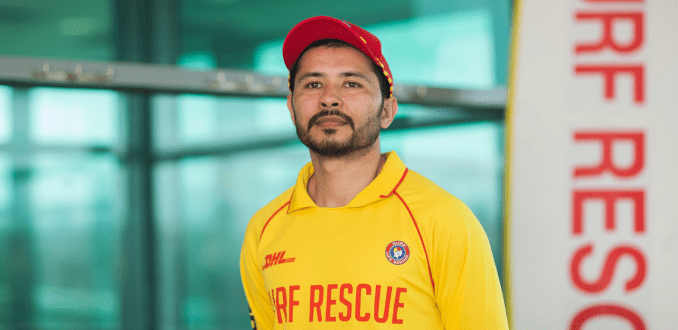
Ramzi: Life Saving Victoria
Many pivotal moments in Ramzi’s life have involved water. When he was 16 years old he came to Australia by boat as an asylum seeker from Afghanistan. Travelling alone, he was conscious, during those long days and nights on the water, that he didn’t know how to swim. In Australia he got into trouble whilst swimming at a pool. One day Life Saving Victoria (LSV) came to his school and invited students to take part in a water safety program. It was the first time he realised that water was not only dangerous, it could be fun.
With the support of LSV, Ramzi started taking swimming lessons. It took him a year, practising three times a week at the local pool, until he’d mastered it. With his newly acquired swimming skills he became a volunteer surf lifesaver. For Ramzi, the role was not just about ensuring people were safe in or near water. He was a teenager in a new country without close support, and the surf lifesaving club became like family to him.
He was a teenager in a new country without close support, and the surf lifesaving club became like family to him.
It helped him learn the language, understand the culture and make the transition into Australian life. Ramzi has been a surf lifesaving volunteer for about seven years and is passionate about his work. His club, Bon Beach, hosts many water safety education
programs delivered by LSV to teach young people from multicultural backgrounds how to be safe around water. If they are interested, they can go on to train as volunteer surf lifesavers at Bonbeach. LSV partners with many language schools and
community groups who support new arrivals to Australia, and work with students from high schools in lower socio-economic areas. Many young people they train come from families who have never learned to swim. “The parents are often scared to have their children around water,” Ramzi says. “They don’t want their children to be put in a situation where they are vulnerable.”
Ramzi is challenging some of the barriers to volunteering. In many communities, formal volunteering is uncommon, which is the case in the Afghan community. “People just don’t work for free,” he says. Ramzi’s journey as a volunteer has led him
to a position of leadership—in LSV as Diversity and Inclusion Coordinator and in the Afghan community as someone who is looked up to. While this later role was perhaps incidental to his journey, it is no less important. “People value role models,” he says. When people in the Afghan community see him succeed, they take notice and come to him for advice.
“People value role models,” he says. When people in the Afghan community see him succeed, they take notice and come to him for advice.
They refer their friends and family members to LSV programs and the young people go back to their schools and friends and talk about the program. This brings more people to LSV and encourages them to participate in the programs.
Ramzi believes role models are crucial for young people in his community. Without this form of leadership and guidance they struggle to settle, to transition. “They don’t know who to go to… and they may not listen.” For Ramzi and other young arrivals
like him, volunteering has provided not only skills, structure and a place to put their energy. It has helped them find a place to belong.
~ Author: Trish Prentice
~ Find the entire report and more stories here: https://scanloninstitute.org.au/publication/serve-and-protect
Scanlon Foundation Research Institute Socials:
Twitter: @Scanlon_Inst
 Diversity Australia Magazine