
DAM: Today we’re sitting down with Directors Joseph Archer and Sky Cheema (who also stars) of the short film ‘The Sikh Soldier’, which details the incredible story of an Indian soldier fighting for the British Empire in World War One. Joseph, Sky, thanks for speaking with us all the from the UK! This is an incredible – and quite untold story. Did you both meet on the film or did you know each other prior? How did this story come to be?
JA: We met on my first short film actually. We’d got some funding and even a place to do some proper in person casting and we were casting for some roles and I made the mistake of saying to a mate of mine – ‘Oh, yeah, just come along to the casting and you’ll get the role because I think you’ll be good for it’. And then we did in person castings and Sky walked in the door and just does such a good job and does it in a way that I wasn’t expecting. And it was quite humiliating for me because I had to go to my friend and be like, ‘Sorry, I’m going to have to give it to this stranger, this new guy’. And that was the first project that me and Sky worked on.
JA: He acted in that role as one of the main people in the ensemble cast. But yeah, if that was a lesson I ever learned was – don’t promise anything until you’ve given everyone a fair chance. And that’s the thing actually about in person castings. It’s so worth doing. And so from there, me and Sky have done loads of projects together now. I think we’ve written it into each other’s contracts that we must work with each other on every project! [laughs] But it feels like that. But then when we promoted ‘On In 15’ (2019), Sky was always up for going to the Q&A’s and the screenings and stuff like that – like any actor should. That’s what you’ve got to do, you’ve got to go promote yourself, people won’t come to you – you’ve got to go to them. And so we just started talking about World War I history. 1917 came out. This big blockbuster, Oscar winning film and we were like, why don’t we do a story which, instead of it being like, some white guy, running around with a tin hat, like, why don’t we tell this story [The Sikh Soldier]? Because there were absolutely millions of other people involved in that world war. So why don’t we take it from a different perspective, but still keep the British Empire perspective in there, but tell it from the POV of a Sikh soldier instead. What is it about four years later Sky?
SC: Yeah, you know, I’m surprised our relationship’s lasted that long. [laughs] But yes, It’s coming to the end of another year now, since we’ve first started talking about the project around that little roundabout near Derbyshire.
JA: Oh, yes the actual idea of working together again did happen whilst we were driving around a roundabout in Derby in the midlands of the UK. We didn’t realize that ‘silly little idea’ would turn into a three year long journey, which also included COVID, strikes ect, but luckily, it sorted itself out.
“We didn’t realize that ‘silly little idea’ would turn into a three year long journey, which also included COVID, strikes ect, but luckily, it sorted itself out.”
joseph archer
Actually a lot of big obstacles came in the way just making this project together, but luckily me and Sky sort of stuck with each other and made sure it happened. It’s been a tremendous time, definitely.
DAM: It is such a great story. I remember when I saw the trailer, because as you said, so many people were involved in the war but we don’t get to see all those different narratives and that’s what’s so great about it. Did you find you had to do a lot of research into the specific story? Or did you know anyone who had family involved in that sense?
SC: So for me, growing up as a Sikh, it gets drilled into your head pretty hard and pretty early on. Because Sikh’s are very proud individuals and we like to tell each other all the time, we’re like – ‘we’re a warrior race’, you know, we’re warriors and this and that. If you have a look at all of our history, the main backdrop of it is that we fight for justice and all this. When I was in school, I actually wanted to talk about something in World War I, and my teacher kind of brushed it off and he was like, ‘Just stick to the curriculum’, you know, talk about what the British did, and then I kind of told my parents and they got a little bit frustrated and angry about it, which, you know, it was understandable. But then in one whole night, I learned all about my family history, like, you know, ‘Your grandfather was this and your great grandfather was that’ and I was just like, oh my god, like a millennia of fighting people.
“I wanted to talk about something in World War I, and my teacher was like, ‘Just stick to the curriculum’, talk about what the British did. I told my parents and they got a little bit frustrated and angry… Then in one whole night, I learned all about my family history and I was just like, oh my god, like a millennia of fighting people.”
sky cheema
But it was an interesting process, because we actually went to historians, we spoke to them, people from the UK, Canada, India – we wanted to make sure that if we’re gonna do something along these lines, it’s gotta be faithful towards those individuals. So if you’re gonna do something, make sure you do it right, and make sure that it’s faithful enough that people will both enjoy it and then they will also talk about it a little bit more.
JA: Yeah so we had about a year long research process because we came up with the idea when me and Sky were doing screenings for ‘On In 15‘ – which screened at the biggest cinema in Europe at the BFI. And it was brilliant, we were like, ‘We’re on the up, it’s gonna be so good, let’s get out and make some films’. But instead COVID 19 happened and within a month we were inside just having Zoom calls. So it was quite a good opportunity to really focus on a certain project. So we did lots of research and had Zoom calls with people all around the world about the historical topics. And it’s really important because people don’t really appreciate the numbers. For example, for Australia, about 400,000 people fought for the British empire and that’s just Australia, fighting for a war in another county. Like, it’s just mental to think about that mass mobilization of people that went and fought on the other side of the world and then likewise for India as well – it got to a million people involved in the war in World War I.
“For Australia, about 400,000 people fought for the British empire… It’s just mental to think about that mass mobilization of people that went and fought on the other side of the world and likewise for India as well – it got to a million people involved in World War I.”
joseph archer
So just appreciating that scale rather than just seeing it from like ‘the guys from Derbyshire’ or whatever fighting in the trenches, we wanted to make sure we got all the details right.
JA: The other thing to be said is for a short film in a short format, [you have to think about] what you actually focus on, because there is so much history to tell. It’s like how can you condense that in a way that is sort of entertaining, artistic, as well as informative? That was the biggest challenge, but we did lots of research to make sure that we were taking it from the right angle and telling the right stuff. And also, funders and speaking to backers, was getting an idea of what sort of story they wanted to tell as well. And that’s important is – the people who are going to support you along the way, are you telling, are you sharing that sentiment together?
DAM: So you sought out funding for the short? Was was that process like?
JA: Yeah, we had a huge range of people, backing the film, actually. We first estimated the budget a lot lower than we should have maybe, but we were borrowing – a lot of people were offering stuff for free or at seriously discounted rates. But then the more COVID basically ruined people’s economic outlook – is the nicest way of saying it, you know, things got more expensive. And also we were trying to do a film, which during World War I, The Spanish flu happened, which was like the precursor to COVID. So we were filming that environment during a time of a pandemic. It was a case of going, wait a second, this is going to be very difficult to do safely.
JA: So the shoot kept on getting pushed back and back, which meant we needed more money and things like that to make it safer and better. Which was a good thing, actually, because we had people like the British Film Institute come on board later on. So it was worth the wait because with a lot of filmmakers, it’s exciting making a short film with your friends or your contemporaries being like ‘let’s get this done next weekend, let’s turn this around in less than a year’ – but actually if you do put a bit more time into the project it means that you can work with better people.
“It’s exciting making a short film with your friends or your contemporaries being like ‘let’s get this done next weekend, let’s turn this around in less than a year’ – but actually if you do put a bit more time into the project it means that you can work with better people.”
joseph archer
We worked with some really good actors as well that we wouldn’t have been able to work with if we just made it as quick as possible. We did some crowd funding then we got a little bit of private funding and donations from some historical institutions and charities to help fund it because they’re interested about telling Sikh history, then we got financing from different public bodies, including the British Film Institute. And I’m sure me and Sky put money into it as well. We certainly put hours and hours and hours and hours of our time into it over two or three years, which, I don’t want to work out how much time we spent on Zoom calls, Sky it must have cost us a lot of money.
SC: It wasn’t just that though, for example, one of the things was to make sure that the world looked authentic and real. Me and my family had to build the sets for the World War I trenches. So, it was like, every so often, we’d send photographs to each other, me and Joe, and then we’d say, ‘we probably want this, we probably want that’. And then my dad took a little bit of creative license, and he was like, ‘No, I’m gonna make this’. I think it was like one month, two months go by and then basically Joe turned up when it was a little bit safer and he saw everything that happened and he was like, ‘Oh my God, this is brilliant’. Every single step of this process has been a ride, definitely, because we’ve helped each other out, we’ve motivated each other, even through some very obscene sort of times. I think the strongest thing that’s come out of it is this film is how much our relationship has actually strengthened as filmmakers as well. I mean, if you can get through a pandemic and loads of other stuff that’s gone on for the last three years – just to make one film, I’m pretty sure you’re ready for anything bigger than that.
“If you can get through a pandemic and loads of other stuff that’s gone on for the last three years – just to make one film, I’m pretty sure you’re ready for anything bigger than that.”
Sky cheema
JA: Yeah because the other thing with getting more funding and more funding partners is that you are then accountable and responsible to more people, which of course is more stress and is more time consuming. So, whilst a lot of people, filmmakers and artists, kind of just want to be like, ‘ah, it is whatever, my choice is the best thing’ – it’s like no, when you’re talking about bigger budgets you do get constrained by different things. You need to sort of work in the best way with everybody.
JA: But hopefully with the research and different backers and time that was spent on the script, because even the BFI as part of the funding process, got us a script editor to help us develop the story a little bit with the script – which was quite nice actually. I didn’t think it would necessarily be helpful because I also worry about the the story being corrupted if you have a second set of eyes look over it and go ‘yeah I think you should change this’, and then you think ‘oh it could go wrong if that happens’ and you don’t get the film you want. But actually it is a super helpful process to have somebody not biased to look at the script and go, ‘Actually, I don’t think that works’.
DAM: Yeah, absolutely. So now for the big question – what was it like working together on the set? Particularly with you both directing and acting.
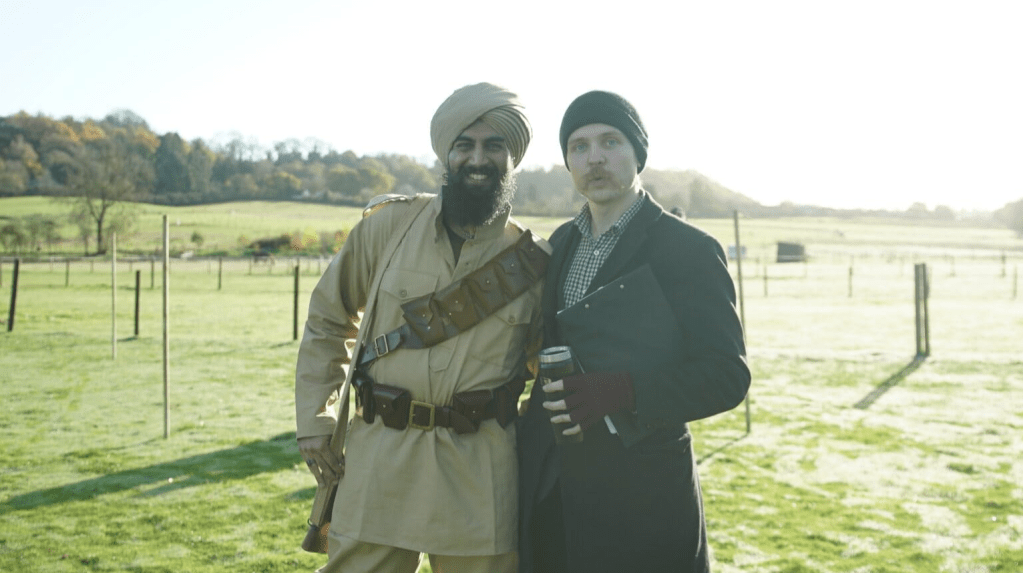
JA: It was madness, I think, but it was really good fun. [laughs] It was really, really funny. And we can’t wait to release the BTS of it. We’re going to eventually do that. But you’ll notice how chaotic it was because of the fact, like one day I think we had close to a hundred people running around and doing stuff. So because you’re trying to tell a World War I thing, you need lots of soldiers and stuff like that and lots of different crew and things. So it was bonkers.
SC: It was nuts. There were times on set where it was like, ‘Oh, uh, I don’t know what Joe’s doing or whatever, but everyone’s asking me to help out with the studio and everything’. So I’d be running around, or I’d just be like, okay, I need to take a break just to ground myself and then get in front of the camera. And then out of nowhere, people would be like, ‘Oh, I haven’t seen Sky in like five minutes. Why is that?’
JA: [laughs]
SC: There’d be someone running around trying to find me. And I’m like – I’m just trying to get into the role! But the other times it was great. I think that’s why I came into this industry because every single aspect of this, as soon as you start filming, is just adrenaline. It’s like heightened automatically and if you’ve been on film, if you’re an actor who hasn’t, who just does acting, you know you’re missing out on some of the fun parts, which is being a part of the crew and helping out and running around everywhere as well. That’s always been my favourite part – I love helping out as many people as possible because it’s just, film set’s are just pure energy. And having someone who enjoys that energy as much as you do, I think we had a fantastic time on set, and I really enjoyed my time with Joe on that as well.
“That’s always been my favourite part – I love helping out as many people as possible because it’s just, film set’s are just pure energy. And having someone who enjoys that energy as much as you do, I think we had a fantastic time.”
sky cheema
JA: No, it was really, really good, and it was funny because of course Sky was acting throughout all of it, he’s in every scene and he was effectively responsible for the sets as well because we were filming at his studio, so it was a case of, he had lots of different hats on. I mean in the end, I had to put lots of different hats on. Because not only was COVID still going around, it was winter as well. And also that week, we’d had lots of industrial action and strikes happening in the UK. And they decided to do a strike during the film. So we had to get loads of people accommodation and driving around the place instead of coming up by train, which added a whole different thing but also meant that some people couldn’t do the shoot. And the costume person got COVID so I sort of had to help out costumes. And then I had to act in the thing which I wasn’t expecting – I even have lines! Not even just standing in the background looking like an idiot. I had to actually say something and I had to say it to Sky! That was the really funny thing, the scene with me and Sky chatting to each other and it got really meta at one point because even though I’m the director behind the monitor, I’m suddenly on set with Sky speaking to him as his character and he’s speaking to me as a character.
“It got really meta at one point because even though I’m the director behind the monitor, I’m suddenly on set with Sky speaking to him as his character and he’s speaking to me as a character.”
joseph archer
JA: It actually blew my mind. It was actually one of the most bizarrely existential things that’s ever happened in my life. Just being like, wait a second, what’s going on now? Like, why am I in a World War I outfit chatting to Sky and how the hell did we get here? Like, this is mental. It was also very strange to be directed by Sky and have it go full circle. But luckily we had loads of people, people we trust and I’ve worked with before as well as new people. The actors were fantastic. The crew is so, so good. We were very lucky.
JA: We only had five full days to do filming. We did other bits and pieces, but just because of budget constraints we decided to do five very busy days. I think to be honest, I only got like three hours sleep or three or four hours sleep each night but no, it was great. It was absolutely exhausting, but enthralling. And like Sky says, you don’t notice it because you are on adrenaline. And we were getting a question asked to us about every minute, you know, we’ve got the production designer or makeup people or the actors or the ADs, extras, you know all these people coming up to you every second asking, and you have to have the confidence and know it doesn’t matter how tired you are or maybe you’re even unsure but you have to confidently be like, ‘This is what I want. This is the plan’. And explain it and communicate it effectively. And when you see it come to life on screen and you think, ‘Oh, all this work has come out really well’. That magic of seeing a world that doesn’t exist, appear – like everybody has worked together just to make this little world in this frame and that is the beautiful thing.
“That magic of seeing a world that doesn’t exist, appear – like everybody has worked together just to make this little world in this frame and that is the beautiful thing.”
sky cheema
JA: And it was a really Diverse set because we wanted to show off the diversity of the war. We had different actors representing different countries in certain scenes and it was really good. It was different to most sets, especially different to most war sets as well. And we had the community as well. The community would come bring us lunch and dinner which was really nice. So it was really a set which involved not only friends and family, but the community as well.
“The community would come bring us lunch and dinner [on set] which was really nice. So it was a set which involved not only friends and family, but the community as well.”
joseph archer
DAM: That’s really amazing to hear that the set was like that. I’m sure that all culminated together to create such a powerful film. And I guess like the last question I want to ask you both is what’s the response been like now that it’s come out and people are seeing it?
SC: There’s a lot of people who want to see it. I still feel because of how big the budget and how good the cinematography and everything looks, everyone’s sort of assuming that it’s a feature film, which, you know, it’s not a bad thing. It’s quite flattering actually, and if people do like the look of it, then I think it can move towards that long feature film length sort of script.
JA: We’ve had some really positive reviews. We’ve been on the news, which is really good – iTV news, which was really good fun. And we’re now starting to do some screenings in the UK. We are sending it off to film festivals, actually today we’re going to send it off to Flickerfest, which is the big film festival in Sydney, so please chat to them and get this story in it! It’s a great film, we will be sending off to more film festivals like FlickerFest to hopefully get selected and screened there. But we will also be doing a few screenings in the UK, getting more reviews, chatting to lovely people like yourself and trying to spread the word of the project out there. But yeah, it’s had a very positive response from reviewers so far. We’ve had a five star review, which is really nice, and four star reviews, which is really good. So yeah it’s been very positive.
DAM: That’s great news and we can’t wait to see it.
JA: Yeah let’s do a screening in Sydney!
DAM: Yeah, let’s do it! Should you get into Flickerfest, we’ll be there representing you.
JA & SC: [laughs]
DAM: Sky, have your family members seen it?
SC: So my family members saw an early version of the draft, they haven’t seen the full thing as of yet.
DAM: Was it up to what they expected or hoped?
SC: Well, to be honest, I think they were expecting something completely different because I never showed them the script because I keep everything very close to the chest. But I think they kind of pieced it all together because they were on set. When we were doing the filming, my mom was in charge of costumes, my dad was in charge of making sure the sets were okay and looking after all the firearms that we had as well. But they kind of pieced certain things together and they understand it and to be honest, I’ve never seen them that emotional after watching just a draft of a film. So, when the film, you know, gets out there, when we have it screened, I’m quite sure that they’ll be over the moon. Like, my mum might not speak and my dad might just slap my back or something –
DAM: – But you know that’s a lot, don’t you?
SC: Yeah [laughs].
DAM: Well congratulations to both of you on such an incredible – and important film. Honestly, we can’t wait to see it. We wish you guys all the best with the rest of the release and thank you so much for speaking to us today. It’s been really awesome to hear more about it.
JA: Yeah. Thanks so much for chatting to us. It means a lot and we look forward to try and get it over to Australia too, can’t wait.
.
.
.
You can find more on the film here:
Website: https://www.thesikhsoldierfilm.com/
IMDB: https://www.imdb.com/title/tt23899806/?ref_=tt_mv_close
Instagram: https://www.instagram.com/the_sikhsoldier/
Facebook: https://www.facebook.com/thesikhsoldier
Twitter: https://twitter.com/TheSikhSoldier1
Joseph Archer Instagram: https://www.instagram.com/joseph_archer/
Sky Cheema Instagram: https://www.instagram.com/skycheema/
.
.
.
Published by Sangeetha Gowda & Marshall-Weishuai Yuan
 Diversity Australia Magazine