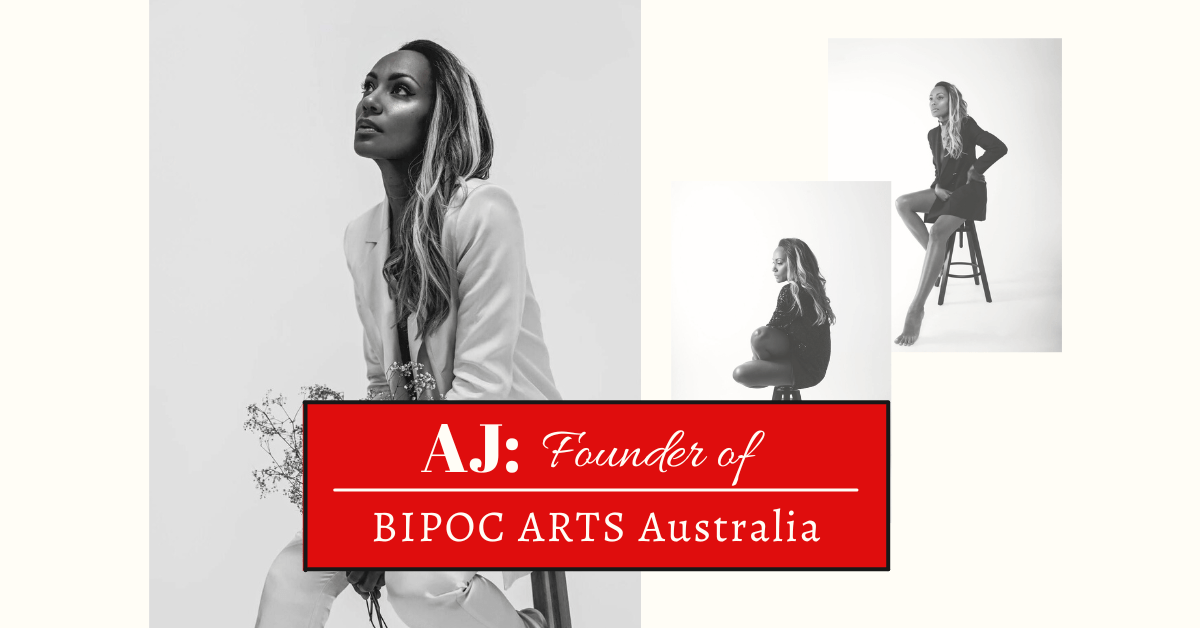
DAM: Today we’re here with the wonderful AJ, Founder of BIPOC Arts Australia. AJ, we’d like to start off by getting to know your background and how that shaped you as a person.
AJ: Yeah so my mother is from the Autonomous Region of Bougainville and my people have the blackest skin on the planet which also gives me quite dark complexion as a biracial person. Being biracial and coming from two different cultural worlds, one with a complete myriad of culture and ethnicity and one not so much [Irish] was a very interesting start to life because it essentially developed two distinct personalities within me as a whole human. I had a lot of trauma and unresolved identity feelings and it all culminated to who I was and who I am now. Coming and going from one world to another can be quite fracturing to an adolescent mind trying to develop a strong identity of who you are. Especially when you have to continually blend into your surroundings and act a certain way. I straightened my hair because I grew up in a world where I couldn’t wear my natural hair because it was frowned upon. So, growing up in two distinct worlds and being biracial had a huge impact on who I am as an adult and as a woman of colour.
DAM: Wow, yeah I can certainly relate to you with being biracial. For me, growing up in Queensland, when I moved to Sydney I found it much more culturally diverse compared to where I grew up. Was that the same experience for you? Did you feel like people were putting you into a box? (Sangeetha)
AJ: So we grew up in the highlands of Papua New Guinea in a town called Goroka which is one of the most culturally diverse places on the planet. Papua New Guinea has the most languages in the world, some people believe we have up to a thousand. We are the most culturally diverse country having up to around five hundred ethnic tribes it’s a complete spectrum. Growing up we lived in an expat community because my father was white, which was also our social network. We did all the things that young white kids did, we rode horses, we were at pony club, we went to the golf club, all the clubs. It was a proper expat world, but we were tied culturally to our country, every other day we were engaged in our cultural events – but always never quite fitting in anywhere. So, then we moved to Maroochydore in the 90s which back then was a small town on the Sunshine coast, very small and very white. At ten years old my brothers and I were the only black people in our school of eight hundred kids. It was racism every day, racial slurs – ‘go back to chocolate land’, getting chased home, a traumatic culture shock.
“At ten years old my brothers and I were the only black people in our school of eight hundred kids. It was racism every day, racial slurs – ‘go back to chocolate land’, getting chased home, a traumatic culture shock.”
It was a horrible, horrible experience but as a child your parents just think you’re malleable and that you’ll be fine. We were there for four years and just when I was settling into a high school we got yanked back to Papua New Guinea, which was also horrible. By then I had grown into a young woman and when I got to high school, my peers who were also biracial, just tore me to shreds. My first day of school someone nicknamed me ‘Pamela Alyson’ (after Pamela Anderson) because I had bigger boobs than everyone else and I just got bullied and singled out because I was starting to look different to everyone else. I came back to Brisbane for one year of high school at a boarding school, but by then I had completely fractured and dropped out. “Why is everyone so mean?’’ “What’s wrong with me?”. From fifteen to eighteen I was a lost child; drugs, alcohol and searching for meaning so it was a very challenging childhood/adolescence. Then at eighteen I packed up and moved to India.
DAM: Oh wow, really? Where abouts?
AJ: I went to Mumbai. I’ve always sung, I’ve always been a singer and I realised that I could get jobs at hotels and contracts. So, I was there for nine months at eighteen and from then to now I’ve just travelled and worked.
DAM: I’m so sorry to hear about that, going to another world and not fitting in. Meeting you in person and how strong and positive you come across, I never would have guessed that’s what happened to you. So how did you become who you are now?
AJ: It took a lot of self-reflection and healing. I’m a very open person so it’s difficult for me to contain emotions. Where a lot of people repress and suppress feelings, I’m unable to do that because I would literally implode. Perhaps it worked in my favour because I always expressed so much, so instead of being this bitter twisted person, everything just comes out creatively, either in music or just talking and writing it down, generally offering love instead of hate and pain. To my biggest critics who’ve tried to destroy me mentally and physically I still offer love and forgiveness. I think self-reflection is a huge component, growth and evolution are two different things. People can grow but how do we evolve to become more than we actually are?
“To my biggest critics who’ve tried to destroy me mentally and physically I still offer love and forgiveness. I think self-reflection is a huge component, growth and evolution are two different things. People can grow but how do we evolve to become more than we actually are?”
DAM: I love that you mentioned openness and how it connects to your creativity. Speaking of how alienated you felt during your youth, did your creativity help you embrace who you are?
AJ: Yeah it did, when I started travelling I realised how racially ambiguous I am outside of Australia and Papua New Guinea. I was [seen as] Brazilian, Jamaican, African, British, American – everything but the two cultures that I am, and I absolutely love it. I can be whoever I want to be. I would always say I’m from PNG, but it was just lovely to not be labelled. When I go back to PNG, I’m always considered too white and told that I ‘act white’ because of my accent but I can’t help it – it’s literally my accent! [laughs] When I come to Australia, people don’t know what to do, “You’re black but you’re kinda pretty, but you speak well”, “You speak very well for a PNG girl” – I’ve gotten that my whole life and I’m like “Have you ever been to PNG?”. Through music I began to understand the impact that I could have through it but there was a lot of darkness to it. I became very much an alcoholic and I guess as a creator there’s two masks, there’s light and darkness and a constant battle to share your art but to hide and not be vulnerable because people can destroy you.
“…I guess as a creator there’s two masks, there’s light and darkness and a constant battle to share your art but to hide and not be vulnerable because people can destroy you.”
I moved back to PNG in 2010 and to this day I can only be who I am, and I’m still not accepted largely by people in PNG because of one reason or another. That’s okay though because once we develop that sense of self, then nothing else matters. I built up a career in Papua New Guinea and that’s all I can do, and I’ve never chased fame, fame has never been at the centre of what I do. I watched ‘Everything, Everywhere, All at Once’(2022) and it really resonated with me because sometimes you see so much; everything, everywhere all at once but you also feel this darkness as a creator as I’m sure you know and have felt. Through creating I’m building more strength in my career as an artist because people are always like, “Do you actually make money?” ‘Is this a proper career?”
DAM: Until you make it.
AJ: Right?! Then it becomes a career but what else do I do? This is my career and I love it. It’s about building the strength in doing what your meant to be doing and everyone else can ‘get fucked’.
DAM: That should be the title quote of the article [laughs]
AJ: Hahaha!
DAM: Well what you said is really relevant especially to what you do and leading on, we’d like to know where BIPOC Arts Australia came about and why you decided to launch it?
AJ: I moved back to Brisbane in 2018, my father had cancer and he passed away in 2019. My husband and son were living in Fiji at the time. After dad died we decided to stay in Brisbane and of course COVID came along. During that time I wanted to reconnect with Brisbane because in my twenties I gigged all over the place. I didn’t want to connect with music though, I wanted to connect creatively so I was looking for BIPOC artists but I didn’t want to scroll through manually. I needed them to all be in one space so BIPOC Arts Australia was born of wanting to connect with BIPOC artists and meet people and see what everyone was doing and support them. It was literally just me – I did my own logo and then frantically inboxed everyone, I’m pretty sure you guys would have gotten one! I just found everyone and offered an invitation and was like ‘hey building a community’. Within three months I had a hundred people which was incredible. It was really just a desire to connect and create. I wanted it to feel like a community that always existed.
“Within three months I had a hundred people which was incredible. It was really just a desire to connect and create. I wanted it to feel like a community that always existed.”
DAM: When I first heard about the page I thought it was a team of people running it and then I found out it was just you and realised how impressive it was.
AJ: People would always say, “Who am I speaking with?” and I was like, I never said we were a huge team, I just said ‘We’ because in that sense I’m talking about people who have exactly the same values and goals. The team is growing at the moment however and I’m starting to take on people. It’s always been there but this [her fingers typing] has always been there.
DAM: So with the page and how quickly it’s grown, have you found that people have been wanting something like this to exist? How have people been responding?
AJ: Very much, that’s always been the most consistent thing is “Thank you for starting something like this”. I was so overwhelmed by the positive response I was like – where do I go from here? The aim at the beginning was building a community where people could find each other as well as me finding them and then from there I wanted to do things which would support BIPOC Australia which led to the grants coming along and create projects. It’s very organic. I really tried to keep that ‘community’ sense at the forefront because more than just being able to support and provide opportunity, it’s the space itself that’s important. I wanted to make sure that it never came across as an agency where I could get work for other artists. It was just an open invitation to share your information on the platform, which is a BIPOC only platform which I make very clear. I’ve had non BIPOC organisations looking for talent and the first thing I ask is their DEI policy. One lady just shared a Shakespeare quote as a DEI and I said – do you even know what a diversity, equity, inclusion policy is? Sometimes I’ve had altercations, but I’ve also had non BIPOC agencies say “How can we help?” “What can we do to better our organisation?’‘ – which is great because those are the conversations you want to have. When I started, quite a few POC organisations reached out to me to which I found that some were very ‘anti non POC‘ which was very….
DAM: Yeah well you’re still half white –
AJ: – Yeah but I was like ‘I feel that power and understand it’, but for me I feel as though these difficult conversations can only be approached with kindness, love and compassion. I’ve had people have the most ridiculous conversations with me and that’s okay because that’s all they know and once we understand that it’s all very environment based, we can better navigate it. So that’s why BIPOC is a platform of understanding.
DAM: It’s crazy because that’s all the things we’ve been saying ourselves. As actors who’ve also delved into filmmaking and producing it’s really helped us elevate our knowledge especially being a POC. I mean, many BIPOC stories are still being written by non BIPOC writers, so to have the skills behind the camera as well as business is really essential. At the same time we understand how business is hard for creatives since it’s so opposite of what we do.
AJ: You’re right and the skills and the mental processing aren’t always readily available. I’m realising how important business is in the creative world and how many creatives don’t have those tools or they don’t understand business and don’t know how to build their business or represent themselves so I’m focusing on that at the moment. There’s a very real need to teach people how to create income for themselves and create standard business practices.
You’re right, it’s all directed by certain groups of people. But I definitely want to set up a production house, we have to be able to tell our own stories like what you guys are doing and congratulations by the way. It just brings that hope and you’re such an inspiration to people. We’re all fighting the same battle.
DAM: Likewise with BIPOC Arts! When we look at your page we are so inspired by how much you’re building a community around BIPOC arts in Australia. Well, to wrap up, would you have any final words of advice for BIPOC artists trying to get into the creative space or even business side of things?
AJ: Communication is very important and reaching out to people. It’s not being afraid and having courage. First and foremost it’s taking steps to get to know yourself and really putting the work into building yourself worth and identity. Once that is strong then we are better able to navigate our world as creatives which can be sometimes very high or very low. When the industry is quite tumultuous and unstable, that strong sense of self is our stability and carries us through.
“When the industry is quite tumultuous and unstable, that strong sense of self is our stability and carries us through.”
Reaching out is important, even if it’s just to have a conversation. That human connection is something that artists both love and detest, we love to share but we can also be very agoraphobic. As artists we embrace change and, in our industry, change comes quicker because we understand fluidity and evolution.
DAM: Well we’re both so proud of you and thank you for sharing your story with us AJ. We always love connecting with people who understand creativity and serve to inspire others, particularly as BIPOC creatives. Thank you so much for taking your time.
AJ: Thank you so much and thank you for reaching out to me, it’s been a privilege.
 Diversity Australia Magazine